


Use MFL’s League History report to find previous season league links.
Get your MyFantasyLeague league into Fantasy HofF
You sign in to Fantasy HofF first, then connect your MyFantasyLeague league. Here’s what to do at each stage.
Sign in to Fantasy HofF ↗- 01
Sign in with your email
Enter your email on the Fantasy HofF sign-in page and follow the email verification instructions. The link above returns you to Add league with MyFantasyLeague selected.
FANTASY HALL OF FAMEYour league starts here.[email protected]Illustrative sign-in flow · not a form - 02
Choose MyFantasyLeague
In Fantasy HofF, start Add league and choose MyFantasyLeague. Paste an MFL league URL to look up a public league.
Private leagues and manager names may require an MFL sign-in. Use the connection flow shown in the importer, then review the available leagues and seasons.
Have your original league link readyConfirm the league and season list before choosing what to import. - 03
Review the seasons. Match the franchises.
Check the selected year range and match franchises carefully across seasons. Preserve the original scores rather than recalculating old seasons under today’s rules.
EXAMPLE SEASON REVIEW2023Sunday ScariesCheck identity2024Fourth & LongReview rename2025Fourth & LongSame franchiseIllustrative review checklist. Actual screens and available seasons depend on your provider.
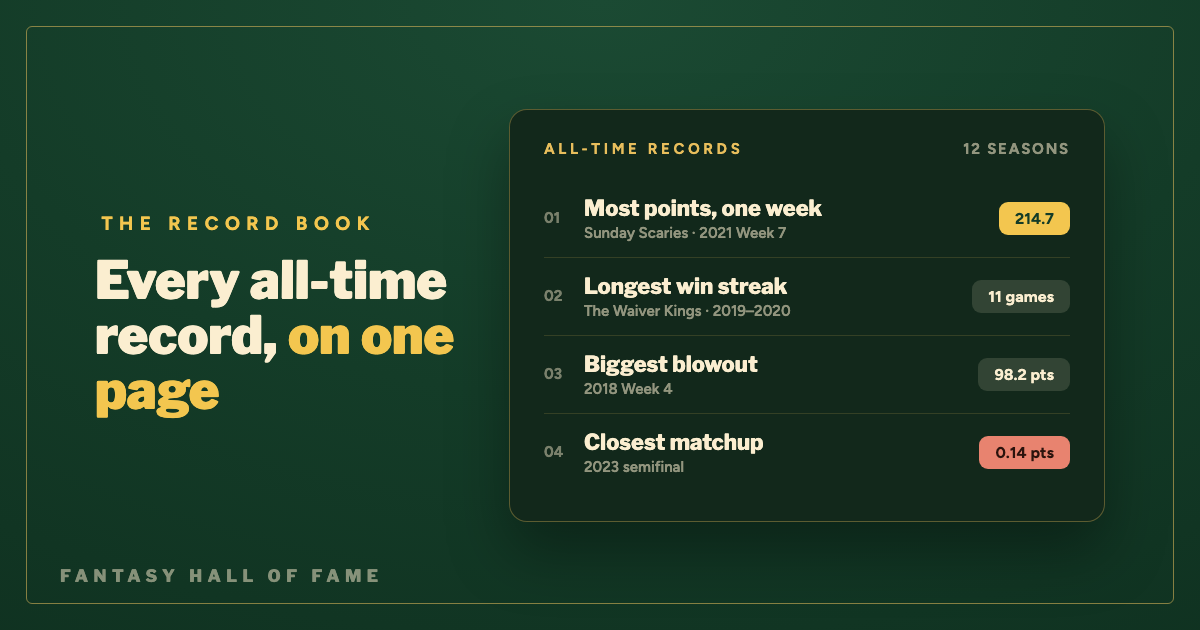
Start with the champions and record book. Compare one known season to the source before sharing it with the league.
How to find your MyFantasyLeague league history
Start with the League History report
Open your MFL league and find the League History report. It links to prior season leagues, which are the starting point for reviewing historical results.
Keep the year with the league link
MFL league URLs include season context. Save each relevant year’s original URL, and confirm that the league ID and franchise identities belong to your group.
Check the rules behind the records
Review the scoring and schedule for the season you are comparing. Doubleheaders, divisions, and scoring changes can make a simple one-game-per-week assumption misleading.
What MyFantasyLeague league history can include
Swipe across the table to see all columns →
| History to look for | Where to start | What to verify |
|---|---|---|
| Previous annual leagues | The League History report links to earlier seasons. | Keep the year attached to every league URL you save. |
| Public and private reports | Public links support lookup; restricted details may need an account connection. | Public team names alone may not establish manager identity. |
| Custom schedules | MFL supports formats including multiple matchups in a week. | A team’s games played need not equal the number of weeks. |
| Scoring and draft context | Preserve season rules and identify the relevant draft or auction. | Changing rules make raw point totals across eras harder to compare. |
Compare records in their original scoring context
A 200-point week under one scoring system is not necessarily better than a 150-point week under another. Keep the source season attached to every record, and verify unusual schedules against the original MFL reports before sharing an all-time claim.
Check scores, standings, drafts, and lineups separately. Coverage varies by year and provider; an import cannot restore data the source no longer exposes.
Missing MyFantasyLeague league history? Start here
The league link opens the wrong season
Use the original annual link from the League History report and confirm the year displayed on the page. Do not treat the numeric league ID alone as sufficient season context. Keep the complete original URL in your archive worksheet.
The public lookup has team names but not managers
If manager identity is needed, use the MFL account connection offered by the importer. Until those identities are available, cross-check with the commissioner instead of guessing that similar franchise names identify the same person.
The win total looks higher than the number of weeks
Inspect the original schedule before calling it an error. Multiple weekly opponents or additional standings results can make a one-win-per-week assumption wrong. Keep schedule-specific context next to the record and compare like-for-like competitions.
Building an MFL dynasty archive across scoring eras
Start with final results under the rules actually used in each season. If your league switched to superflex, added IDP, or changed reception scoring, preserve that change in a season note. Historical results should tell the story of the competition people played, rather than silently applying today’s rules to the past.
For example, label a points record as the highest weekly score in the current scoring era when that is the range you verified. Keep an all-time championship list alongside era-specific scoring records. Those answer different questions and avoid turning a scoring-system change into a misleading claim about a manager’s best season.
How to build an accurate all-time record book
Before comparing managers across seasons, decide what each record includes. A season champion, a regular-season points leader, and a franchise’s lifetime win total answer different questions. Keep the original results and explain your counting rules.
Swipe across the table to see all columns →
| Record | What to save | What to check |
|---|---|---|
| Championships | Champion, runner-up, final score, season link | Use the actual title-game outcome; check multi-week finals. |
| All-time wins | Final matchup outcomes with season and week | State whether playoff and consolation games count. |
| Highest weekly score | Team, points, week, season, scoring format | Separate scoring eras when major rules changed. |
| Head-to-head rivalry | Both franchise identities and each final result | A renamed team can still be the same franchise. |
| Draft history | Season, draft type, pick or auction result | Keep startup, rookie, and supplemental drafts distinct. |
Same franchise. Two names. One record.
A team goes 8–6 as “Fourth & Long” in one regular season and 9–5 as “Sunday Scaries” the next. If your league treats those as the same continuing franchise, its combined regular-season record is 17–11. Keep any playoff wins in a separately labelled total. If the owner changed, distinguish franchise history from the new manager’s personal record.
Download a MyFantasyLeague league history worksheet
Use this CSV as an inventory before importing or switching platforms. Open it in a spreadsheet and add one row per season. It is a planning worksheet, not an import file for Fantasy HofF or MyFantasyLeague.
MyFantasyLeague archive worksheetSeason · original URL · champion · coverage · missing details↓Keep evidence alongside the spreadsheet
Save a clear copy of the final standings and championship result where you have access to them. Name supporting files with the year and report type so they can be matched to the right row. Never put account passwords or session cookies in an archive worksheet.
When a year is incomplete, write down exactly what is missing: an inaccessible season, a missing draft, or a lineup report without player points. This gives the next commissioner a concrete task and avoids treating a partially preserved season as either fully complete or entirely lost.
Before you call the archive complete
- Save the season-specific league URLs.
- Check franchise continuity when IDs or owners have changed.
- Verify doubleheaders and scoring changes against the source reports.
The platform changes.
The history stays yours.
Bring available seasons into one museum, connect the franchises, and give your league’s records a home.
Build your league museumA few things commissioners ask
Do I need to sign in for a public MFL league?
The importer can look up a public league from its link. Restricted data, including private leagues or manager names, may need an account connection.
Does MFL already keep old seasons?
MFL keeps previous season data and provides history reports. Fantasy HofF adds a dedicated museum and a way to combine available MFL seasons with your league’s other platform eras.
Why does a season-specific MFL URL matter?
The annual league page identifies the season context for its results. Saving the full URL makes it easier to revisit the correct archive and prevents accidental comparisons against the current year.
Will every unusual MFL format produce the same record book?
Do not assume that. Check the original competition format and the importer’s resulting coverage. Standard head-to-head, extra weekly results, and other formats can require different interpretations of wins and games played.
Should old MFL scores be recalculated using our new rules?
For an official historical archive, preserve the results used to decide that season. A hypothetical recalculation can be interesting, but label it separately from the actual standings and championship.
Sources & further reading
Provider navigation can change. These instructions were reviewed against the available provider help and Fantasy HofF importer flows in September 2026.
Next: write a league newsletter with a ready-to-use template →