


Copy the template, fill in the final scores, and lead with the one result everyone will be talking about. A good league newsletter needs a point of view, not a recap of every NFL game.
A fantasy football newsletter template you can copy
Use this for your weekly commissioner email, league message board, or group chat. Remove any section that has nothing useful to say that week.
What it looks like filled in
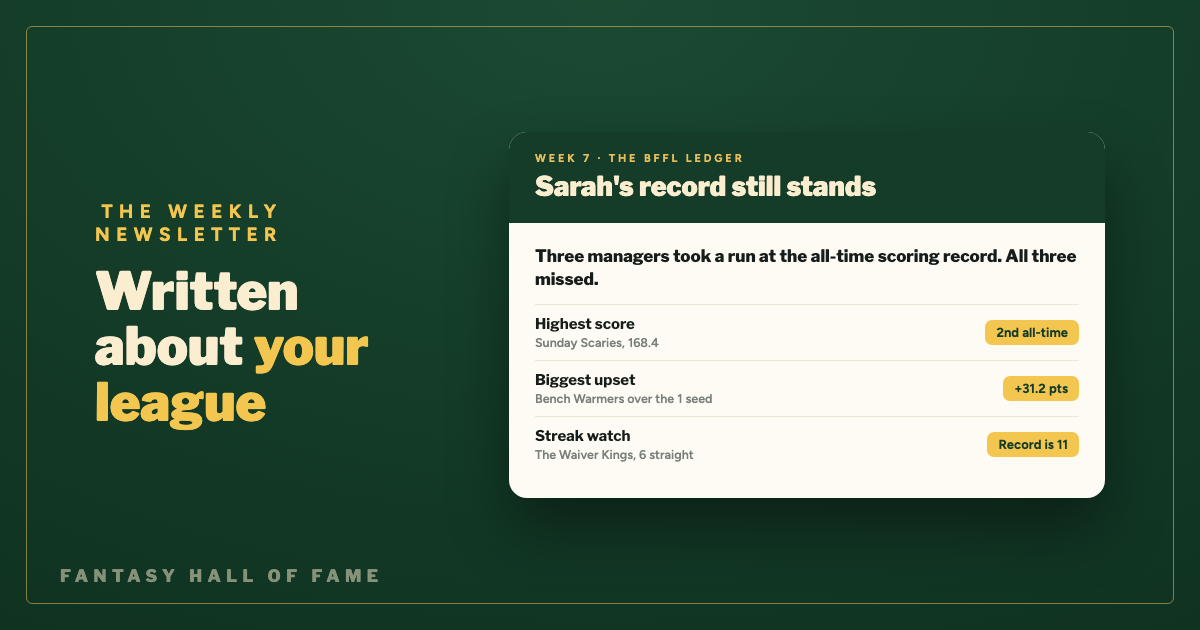
This fictional eight-team league uses one matchup per team each week and 0.1 points per receiving yard. The scores, records, and names below are invented to show the format.
FROM TEMPLATE TO YOUR OWN LEAGUE
Want the story without starting from a blank page?
The League Ledger turns your league’s available results and history into a newsletter. Start on the newsletter page, then follow the setup for your league.
- 01
Start with The League Ledger
Use your email to begin, or continue with your existing Fantasy HofF account.
- 02
Choose your league
Follow the product’s setup to connect or select the league you want the newsletter to cover.
- 03
Give the results a story
Explore your league’s recap and historical context. Coverage depends on the data available for your league.
Prefer to write it yourself? The templates on this page are free to copy and download.
Make the template sound like your league
Lead with the consequence
“Fourth & Long won” is a result. “A 0.6-point escape keeps Fourth & Long in the middle of the playoff race” tells the league why it matters. Use the actual standings before making that claim.
Pick one moment, then show the receipts
Use a close finish, a scoring high, or an old rivalry. Include the score and margin. Call something an all-time record only after checking the available history and stating its range.
Let the jokes come from shared history
A renamed team, a rematch of last year’s final, or a familiar bench decision gives you better material than a generic player joke. Keep the tone one the whole league is comfortable receiving.
End with something useful
Preview one matchup, include a commissioner deadline if there is one, and stop. Remove waiver advice and player rankings unless they genuinely serve this particular league.
Five angles for a quieter week
The rivalry edition
Revisit a head-to-head record, with the seasons you checked.
The halfway report
Compare today’s standings with the same point last season.
The new-name edition
Tell the story behind a franchise’s latest rebrand.
The playoff picture
Show the current race. Verify tiebreakers before claiming a team has clinched.
The season send-off
Celebrate the champion, the closest finish, and a rivalry worth carrying forward.
Three more fantasy football newsletter templates
A weekly recap is only one kind of league update. Use these formats at the points in the season when managers need a different story. Each opens into an editable, copyable template.
Season preview Before the first matchup
Introduce the season’s stakes, new managers, and agreed rule changes. Keep this separate from a draft-grade email: it is the league’s opening chapter, not a set of player projections.
Playoff preview After the bracket is confirmed
Show the actual bracket and explain the rules that decide a tie. If the regular season is still running, call it a playoff race instead and avoid presenting unverified scenarios as clinched outcomes.
End-of-season recap After the final is settled
Create the issue people will look for years later. Record the final, distinguish the playoff champion from the regular-season leader, and include the original season link so the next commissioner can check your work.
Fantasy football newsletter subject lines
A subject line should tell a manager why this issue is about their league. Lead with a result, a rivalry, or a deadline. Avoid calling every week historic: save that word for claims your records support.
Swipe across the table to see all columns →
| Story | Subject-line template | Editorial check |
|---|---|---|
| Close finish | [Winner] survives by [margin] — [League], Week [N] | Use only after the final score is confirmed. |
| Rivalry | [Team A] gets even — the Week [N] league recap | Check the earlier result that makes it a rematch. |
| High score | [Team] sets the pace with [points] | Safer than “record-breaking” when you have not checked all seasons. |
| Playoff race | [Number] weeks left. Here’s where [League] stands. | Explain the current standings without inventing clinching scenarios. |
| Championship | The [year] champion is crowned: [Team] | Use the playoff outcome, not just regular-season first place. |
| Archive milestone | Ten seasons, one league: the anniversary issue | Count seasons played, not merely calendar years since creation. |
A repeatable weekly commissioner newsletter workflow
Collect the results in one place
Write down each final score, the updated standings, and next week’s matchups. Check whether the league uses regular head-to-head wins, an extra median result, divisions, or a special playoff format before summarizing the table.
Choose the lead before writing the recap
Pick the result that most changed the league’s story. The top scorer is not automatically the lead: a narrow win between teams fighting for the final playoff spot may matter more. Use the actual standings to explain the consequence.
Add one piece of historical context
Check a past final, a rivalry record, or a franchise milestone. State the seasons included. If your archive begins in 2018, say “highest since 2018 in our available records” instead of claiming an unverified all-time high.
Edit for the people receiving it
Keep the scoreboard easy to scan, explain inside jokes for new managers, and cut repeated commentary. Use a consistent league voice, whether that is a dry newspaper recap or a friendly commissioner note.
Send, then save a dated copy
Use the channel your league already reads. Keep the final text with its season and week so the newsletter becomes part of the archive. If a stat correction changes a result, update the saved copy and clearly flag the correction.
Email, group chat, or league message board?
Swipe across the table to see all columns →
| Format | Best use | How to adapt the template |
|---|---|---|
| A complete weekly issue people can return to | Use short sections, a readable scoreboard, and descriptive links. | |
| Group chat | A quick recap and a prompt for discussion | Keep the lead, closest finish, and next matchup; link to the full issue. |
| League message board | An archive within the league’s existing routine | Put season and week in the title, and keep the same heading order. |
Using photos and screenshots in your newsletter
A league trophy photo, a draft-night picture shared with permission, or a crop of the final scoreboard can add context. Give the image a caption that explains the connection to this issue. Keep scores and deadlines in the text too, so the message still works when images do not load.
For mobile readers, use one column and avoid putting every matchup into a wide image. A short text scoreboard is easier to search, copy, and revisit next season.
When to automate your fantasy football newsletter
The repetitive part is collecting results and connecting them to league history. The part that benefits from a commissioner is judgment: the joke that will land, the vote people need to understand, or why a particular rematch matters. Start with a consistent template so you know which work you want a tool to handle.
The League Ledger is built around your league’s results and history. Review its output with the same checks you would apply to a manual issue: final scores, record coverage, manager identity, and any special competition rules. Keep custom announcements clear and separate from statistical claims.
The two-minute pre-send check
- Wait for final results and check for relevant stat corrections.
- Recalculate the winning margins from the final scores.
- Use your league’s actual standings and tiebreaker.
- Label historical claims with the seasons covered.
- Remove placeholders and double-check commissioner deadlines.
Newsletter questions, answered
How long should a fantasy football newsletter be?
Aim for a few minutes of reading: a short lead, the scoreboard, one featured matchup, and a look ahead. The template is a starting point, not a requirement to fill every section.
When should I send it?
Send after your league’s weekly results are settled enough to summarize. If a stat correction changes a result later, update the affected claim instead of leaving a misleading record.
Can I use this template for free?
Yes. Copy it, edit it, and use it for your league. You do not need a Fantasy HofF account to use or download the template.
Where do I find the history for an all-time record?
Start with the original provider’s historical seasons. Our platform guides explain where to look and what data may be missing. Fantasy HofF can bring available seasons together into a league museum.